Skip to Content

Tag Archive: tool maintenance

  1. Custom CT & HSS Tooling: EOASAW Can Help!

    Comments Off on Custom CT & HSS Tooling: EOASAW Can Help!

    Can’t find a stock tool for your cutting situation? Edge of Arlington can help you with a unique cutting solution tailored to your particular needs. We are experienced in a wide variety of materials, applications, and processes. We have on-site manufacturing capabilities and represent some of the finest industrial manufacturers in the world.

    Purchasing custom tooling doesn’t have to be complicated, intimidating, or mysterious. It is really a simple matter when broken down in steps:

    1) Gather information

    The more information we have to work with, the better. Many times the type of tool that we will design will be dictated by the machinery to be used, material to be cut, ability to hold the material, etc.

    2) Supply profile to be cut

    Please supply a wood sample, dimensional drawing or .DFX file of the profile to be cut. If the profile is too large it may be necessary to break up the cut, utilizing multiple tools.

    3) Drawing approval

    Once we have all the information and your profile, we will supply a detailed print for your final approval. Please make sure that you verify the information closely as custom tooling is not returnable after approval. The print will have a unique identifying number for easy re-ordering and will include details, such as tool rotation and orientation.

    4) Tool delivery

    Delivery of custom tooling can vary greatly from a few days to many weeks. Some processes, such as heat treatment or grinding diamond, cannot be sped up. We try to work with our customers to deliver in the time frame needed. We have on many occasions performed near miracles, such as overnight delivery; however, that can come at great cost and is not always possible.

    There are too many cutting situations to try to cover all possibilities. Please fill out the request for quote form with your contact information and as much other information as you can supply. We will contact you and ask specific questions as needed.

    Examples of basic information can be found on our Custom CT & HSS Tooling Page.
  2. Tips to Safely & Efficiently Prolong the Life of CNC Tooling

    Comments Off on Tips to Safely & Efficiently Prolong the Life of CNC Tooling


    • Dead stops, also known as “dwelling in the cut,” can lead to premature tool wear and failure. When changing directions of travel or when cutting small pieces, a one second stop at 18,000 RPM generates enormous heat and no means of extraction. Imagine rubbing your hands together 300 times per second – a sure way to a blister. This is more of a machinery and software issue. Certain programming techniques can help to compensate, such as ramping, use of loops at sharp outside corners, and the use of exit ramps.
    • Plunge cutting, while this is the oldest and most widely used method of entering the material, it is not always the most efficient. Plunge cutting can lead to chips wrapping around the router bit after repeated plunges. Whenever possible you should Ramp into the cut. This eliminates the heat generated during the plunging process and can eliminate burn marks at the plunge point. Plunging can also cause the bit to “walk” because there is no centering point; this will be evident as oval holes and entry points larger than the diameter of the tool. If you cannot ramp in, a good alternative is to plunge down outside of the workpiece and enter from the side. Spiraling in can also help; whatever it takes to keep the router bit moving.
    • Routing holes is never the optimum choice. Use drills for drilling, routers for routing. Drills turn at much lower RPM than routers do; router bits generate too much heat when drilling. Drilling just a couple of holes per sheet will significantly reduce the life of your tooling; in fact, you will probably dull more drilling the 2 holes than cutting the entire piece. If you do not have drill heads to take advantage of European type boring bits, turn the RPM down as low as possible, 4-5000 RPM at most, and plunge as fast as possible, an upshear will help to remove the chips if hold down is not a problem. On deep holes “pecking” can sometimes help.
    • Small parts and scrap pieces can become projectiles if left after the cutting process without sufficient hold down. They can also be sucked into the dust collector and cause a blockage. Skin cutting and the use of tabs can help to hold small parts.
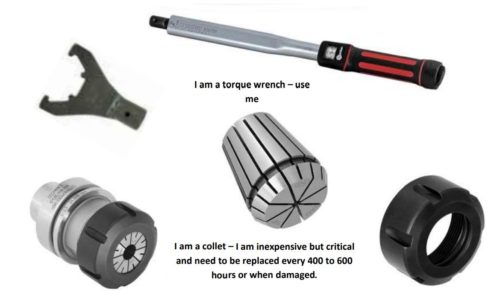
    Collets & Torque Wrenches• Over-tightening of the collet and collet nut is a common mistake. Most operators assume that the tighter the better – this is not true and can lead to premature tool and collet wear and tool breakage. Collets are the most misunderstood and overlooked part of the CNC, often the cause of poor finish, short tool life, and unnecessary machine wear. Collets are made of spring steel and are subject to distortion when put under undue pressure. It is highly recommended that collets be tightened to manufacturers’ specifications with the use of a torque wrench
    • Fires, yes it happens. A tool left in the same place for a sufficient amount of time can and will start a fire. It is important never to leave a CNC running without an operator; you wouldn’t believe how fast things can go wrong. The dust collection system and the vacuum system will aid in the fires speedy travel. If this ever happens to you, beware of flash-back when the vacuum is turned off. When it is safe to do so, it is important to remove and examine the bleeder board and table underneath, embers can remain and once again flair up.

    Check out our free CNC Manual available at EOASAW.com!

    You may also be interested in reading other excerpts from our CNC Manual: Router Bit Tool Geometry, Tool Materials and Their Uses, Factors To Be Considered Before Selecting Your Tool, and Collets & Tool Holders Maintenance.

  3. Collets & Tool Holders Maintenance

    Comments Off on Collets & Tool Holders Maintenance

    Collets and Torque Wrenches

    Collets & Torque Wrenches

    One of the most critical and most over-looked parts of the CNC router is collet and tool holder maintenance issues

    Collets and tool holders are critical parts of any CNC; they should be thoroughly cleaned and inspected during every tool change. Collets are inexpensive and expendable, especially compared to the cost of the tooling that relies on its accuracy.

    Edge of Arlington carries Techniks collets and holders and parts. Guaranteed accurate.

    Collets are made out of spring steel and should be replaced at least every six months of daily use (400-600 hours of run time), or when there is any sign of wear or damage.

    Tools should be tightened with the aid of a torque wrench. Over-tightening can cause distortion and runout, leading to tool wear, breakage, and finish degradation. Under-tightening can lead to bit slippage and twisting in the collet. Torque wrenches should only be used to tighten; using a torque wrench to loosen a nut can lead to miscalibration.

    When using full grip collets, whenever possible the tools should be chucked to fill 80% of the depth of the collet. Fillers are available to prevent collet collapse in the event the 80% rule cannot be maintained. Full grip collets have slits running from the top and bottom.

    Never chuck up on the cutting edge of the tool but always just below the fade of the flute.

    The tool holder is also subject to wear and should be inspected regularly for wear and damage. 

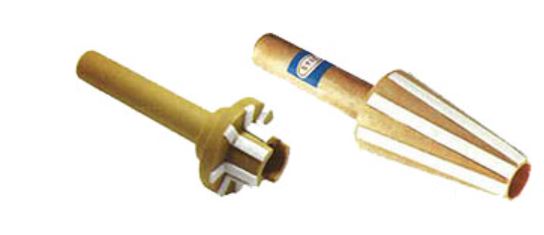
    Spindle wipers for collets

    Techniks Spindle Wipers

    Collet brushes are available for cleaning. Clean using a nylon or brass bristle brush only. Use alcohol after cleaning to ensure there are no chemical residues remaining.

    Spindle wipers are available for cleaning the spindle where the tool holder mounts. Real lambskin provides the best cleaning.

    Recommended torque is based on the style of collet used in the tool holder. An HSK tool holder for example is available with several collet options. Torque has been calculated based on the unique properties of each collet style.

    While changing the bit, it is important to use a set-up fixture or similar device to hold the tool holder safely. Damage to the tool, holder, or operator can occur if the holder is dropped or clamped improperly.


    Remember! Over-tightening can distort collets, causing runout problems and premature failure of the collet, tool holder, and cutting tool. Improperly tightened tool holders are a safety hazard. Always use a tightening stand and torque wrench to tighten collet nuts and pull studs.

    Cutting tools last longer when you … Torque it right!

    If you have a question, feel free to ask us in the comment area, or contact us and we’ll be happy to assist you. As well, we look forward to your comments! Thank you for reading.


    For more, refer to our CNC Manual. 

    To peruse our online catalog or to place an order, visit EOASAW.com or call us at 817-461-7171.

    For more informative EOASAW blog posts, visit our main Blog Page.