Online Orders Only SALE! 10% off all Freud & Diablo Products! 20% off all Techniks CNC Accessories! 10% off Sale on all Southeast Tool! We Offer Quantity Discounts with Whiteside & Viking! New Lower Prices on entire stock of Vega Tools!
Our Spektra™ bits feature a nACo® nanocomposite coating with an extreme nanohardness and heat resistance. With a brilliant distinctively-tinted coloring nACo provides additional improvements in four critical aspects of router tooling.
Posted by Kathryn Magendie on | Comments Off on Router Bit Tool Geometry
There are a lot of different geometries involved in making a router bit—clearance angles, grinding angles, hook angles, axle angles, side clearance angles, radial clearance angles, and side rake. For the purposes of our discussion we will only talk about the basics.
Tool size is a determining factorin how fast you can cut and what types of geometries and clearance angles are possible—all major factors in productivity, finish, and consistency of parts.
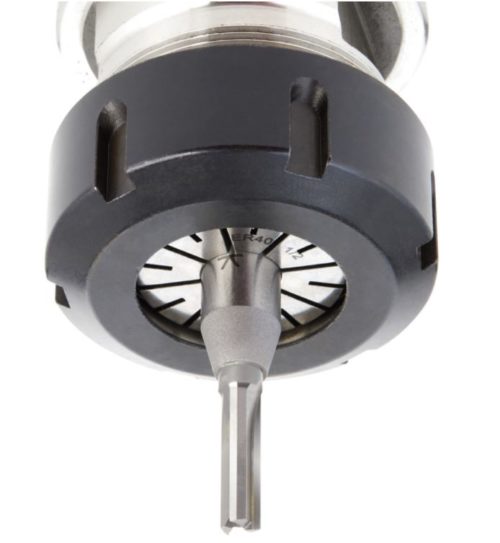
For stability, choose the shortest cutting length possible. You should have sufficient shank to fill 80% of the collet. Longer router bits will deflect more—run-out is more exaggerated the longer the tool.
The larger the diameterof the tool the faster you can go—up to a point. While a 3/4” diameter bit will be able to handle a much larger chipload than a 1/8” diameter bit, larger bits require slower speeds for safety reasons. The following are general safety guidelines:
Up to 1” Diameter—Maximum of 24,000 RPM
1” to 1-1/2” Diameter—Maximum of 18,000 RPM
1-1/2” to 2-1/4” Diameter—Maximum of 16,000 RPM
2-1/4” to 3” Diameter—Maximum of 14,000 RPM
3” to 3-1/2 Diameter—Maximum of 12,000 RPM
Use the largest shank possible. However, cutting diameters smaller than the shank diameter cause stress points at the transition and can contribute to breakage. Solid carbide tools larger than 1/2” in diameter can be expensive and are designed when extra long lengths are needed. The following are safety guidelines with relation to shank size and head diameter:
1/2” diameter shank—Maximum large diameter is 2”
1/2” diameter shank—Maximum small diameter is 1/2”
1/2” diameter shank—Maximum overall length is 4”
5/8” diameter shank—Maximum large diameter is 3”
5/8” diameter shank—Maximum small diameter is 5/8”
5/8” diameter shank—Maximum overall length is 4-1/2”
3/4” diameter shank—Maximum large diameter is 3-1/4”
3/4” diameter shank—Maximum small diameter is 5/8”
3/4” diameter shank—Maximum overall length is 5”
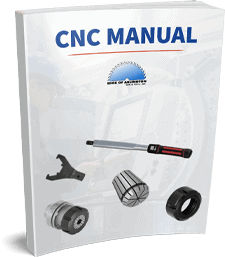
Free CNC Manual
We cover this topic in more detail in our free to download CNC Manual.
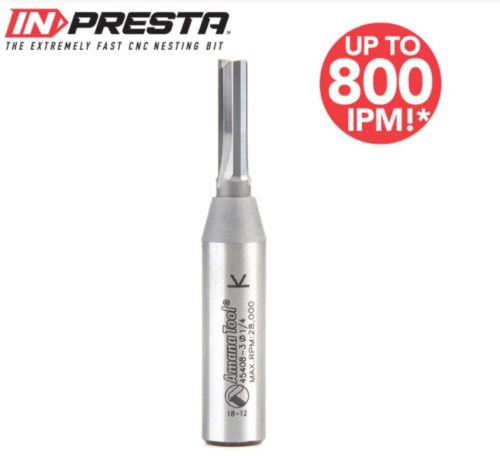
Up to 800 inches per minute!* For cutting 3/4″ material thickness in one pass. 3-Flute for improved surface finish. Only 1/4″ diameter equals minimal material waste.
Use a three-flute bit where fine finish is paramount. Three flutes balance the bit, eliminating vibration that degrades the cut finish. Three cuts per revolution yield a smooth surface and increased feed rates. 45408-3 features a solid carbide cutting edge.
Excellent for nesting and grooving at an extremely fast feed rate, which increases cost savings.
1/4″ cutting diameter CNC nesting router bit with solid carbide cutting edges brazed into steel 1/2″ shank.
The unique design contributes to superb performance and excellent cutting results.
Designed primarily for high speed CNC production.
Long lasting, fine micrograin extra hard carbide results in long tool life before re-sharpening.
Excellent for Cutting:
Laminated Particle Board, MDF & Melamine: Feed rate up to 800 IPM** at 18,000 RPM***
Plywood: Feed rate up to 500 IPM** at 18,000 RPM***
*Up to 800 IPM feed rate at 18,000 RPM cutting laminated particle board. Rate may change depending on material and CNC machine type.
**IPM: Inches Per Minute
***RPM: Revolutions Per Minute
Fusion 360 compatible tool file for 45408-3 available for download, CLICK HERE.


 There are a lot of different geometries involved in making a router bit—clearance angles, grinding angles, hook angles, axle angles, side clearance angles, radial clearance angles, and side rake. For the purposes of our discussion we will only talk about the basics.
 Fusion 360 compatible tool file for 45408-3 available for download,