
Let EOASAW Make You Custom Inserts
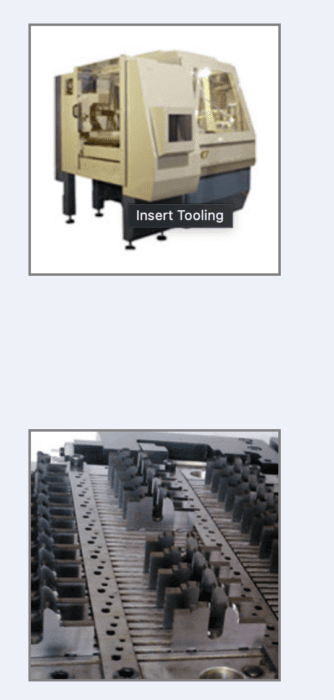 With insert tooling, the carbide is affixed to the tool body by the use of gibs and screws instead of being brazed / welded on. There are two basic types: dedicated insert heads and universal insert heads. With dedicated heads the body is machined to match the profile of the insert to provide support. With universal insert heads the body is open and does not provide support; instead, there is a “backing plate” that is profiled the same as the insert to provide support. With the Universal design you are able to use the same head with multiple profiles by changing the backing plate and inserts. The Universal design is generally more expensive since it consists of an additional backing plate and the inserts are in general larger to accommodate a variety of profiles. We would be happy to help you select the style that will work best for you.
Where can insert tooling best be utilized?
Insert tooling is appropriate in a wide variety of applications – just about any application where you currently use a carbide-tipped tool. There are some common profiles available that utilize standard inserts, making them very affordable. Standard Insert heads are very common on edgebanders, standard shaper cutter profiles, planer heads, and router bits. Edge of Arlington can make you custom inserts to match your unique profiles. We will assign them their own unique part number and they will be the same today, tomorrow, or years from now.
Benefits of Insert Tooling
Inserts can provide consistency in production, allowing you to maintain tight tolerances in critical operations such as cope & stick applications. Using replaceable inserts instead of brazed-on carbide allows you to maintain a constant diameter, which simplifies set-up. Insert tooling is also able to utilize harder, more wear resistant carbide than traditional CT tooling. These micro-grain carbides, while more wear resistant, tend to crack when brazed on. While the initial set cost may be more, inserts are more economical over the long run due to the carbide lasting longer. When purchasing a new profile, it is customary to have to order 9 to 12 inserts to cover production set-up costs. However, if you have a brazed cutter, you generally have to buy multiple heads in order to have a back-up for when the tool is serviced. With insert tooling, one 3-wing body and 12 inserts is equivalent to 4 brazed heads – except they should last several times longer due to the superiority of the carbide.
Limitations / Drawbacks of Insert Tooling
While very versatile in nature, the design does not lend itself well to small diameters due to the need to affix the insert with gibbs and/or screws. This is especially an issue when it comes to router bits. Furthermore, there is more user maintenance involved with insert tooling. When the inserts are changed, everything needs to be cleaned and inspected for any damage. Inserts must be properly aligned when replaced in order to maintain the profile. If the inserts are not aligned properly, one wing is going to do most of the work, resulting in distorted profiles, poor finish, loose fits for cope & sticks, or insert failure. Machinery must be well maintained in order to assure tight tolerances. If there is run-out in a cope & stick set for example, the fit is going to be loose. There is no way to adjust the fit with shims as there would be in traditional carbide-tipped stackable sets.
